
Simply
Simply: the AI-native ATS and CRM for recruitment agencies, built from data model to hosting by the people behind TopDevs.
Updated on
Thousands of recruiters
Daily use
10+ hrs/week
Hours back per recruiter
Live in 4 weeks
Switching
The Netherlands
Hosting
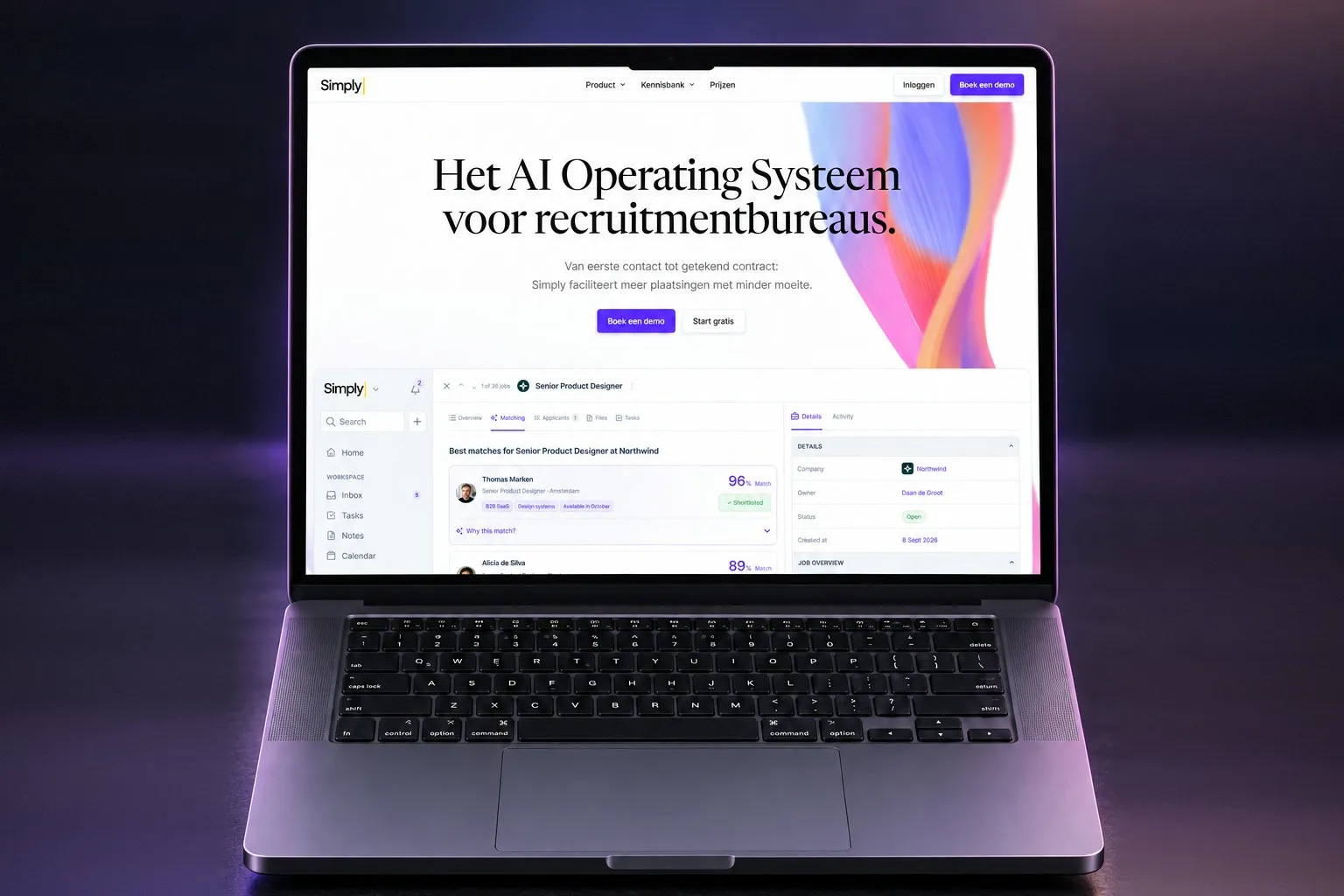
About Simply
Simply is recruitment software from the Netherlands, with offices in Cuijk and Amsterdam. The company started in 2023 with an AI notetaker for recruiters and has grown into a full AI-native ATS and CRM for recruitment agencies. The three owners of TopDevs set Simply up and led it; the same team that builds custom software at TopDevs did all of it from start to finish: the design of the application, the architecture, the first and the last line of code, the servers, and on top of that the brand, the website and the product videos. Simply is ISO 27001 certified, runs on servers in the Netherlands and is used every day by thousands of recruiters in several countries.
The challenge
For its first few years Simply built AI on top of somebody else's ATS. The notetaker wrote call summaries into Salesforce, Mysolution, Byner or Tigris, and the CV parser filled fields in systems Simply had no say over. That worked up to a point, because every new AI feature ran into whatever the system underneath allowed. An agent can't build a workflow in an ATS that has no workflows, and a data model a consultant locked down per customer won't change because someone asks it to. Meanwhile recruiters kept several things in sync by hand: an ATS for candidates, something else for clients, a mailbox, with LinkedIn and WhatsApp on the side. The brief that came out of this was big but easy to state. Build the system yourself, with AI in the foundation instead of bolted on, and make sure an agency can move into it in four weeks.
The analysis
The decision that mattered most was made before the first line of code. Simply wouldn't be an ATS with fixed tables for candidates and jobs; it would be a platform where every object is metadata. A candidate, a job, a company, or an object only your agency uses all run on the same generic runtime. That makes the ATS the first application on the platform, not its boundary.
AI got a fixed place in the write path. Any change a model wants to make arrives as a proposal first and only goes through once a person approves it, behind the same permission check a normal user passes. It costs build time, since every AI tool has to declare which permission it needs; what you get back is a system where you're willing to let AI near your data.
Recruitment data is personal data, so hosting was never a side issue. We chose servers in the Netherlands that the team runs itself, AI processing that stays inside the EU by default, and strict separation per workspace. The ISO 27001 certification was already in place, and the new architecture had to fit inside it.
Existing customers couldn't be left stranded. So the Salesforce app stays for agencies that want to keep working in Salesforce, and anyone who switches gets a migration path with its own team.
Which leaves the question of who builds it. Simply wasn't handed to a vendor that leaves after delivery: the same people design the product, write the code, run the servers, make the website and the videos, and talk to customers. That short line explains a lot of the pace.
What we built

The platform: one data model for ATS and CRM
At the centre sits a metadata-driven platform on .NET 10. Candidates, jobs, contacts and companies are objects with fields and relations you change yourself; a new object gets its own records, permissions and an API endpoint straight away.
4 parts
- Custom objects, fields, relations and views, with no consultant and no migration of the records you already have.
- Pipelines for any purpose, from a recurring hiring flow to a one-off event invite list.
- Roles, teams and permissions down to field level, including what may and may not pass through AI.
- Every change to the model is written with its audit row in the same transaction.
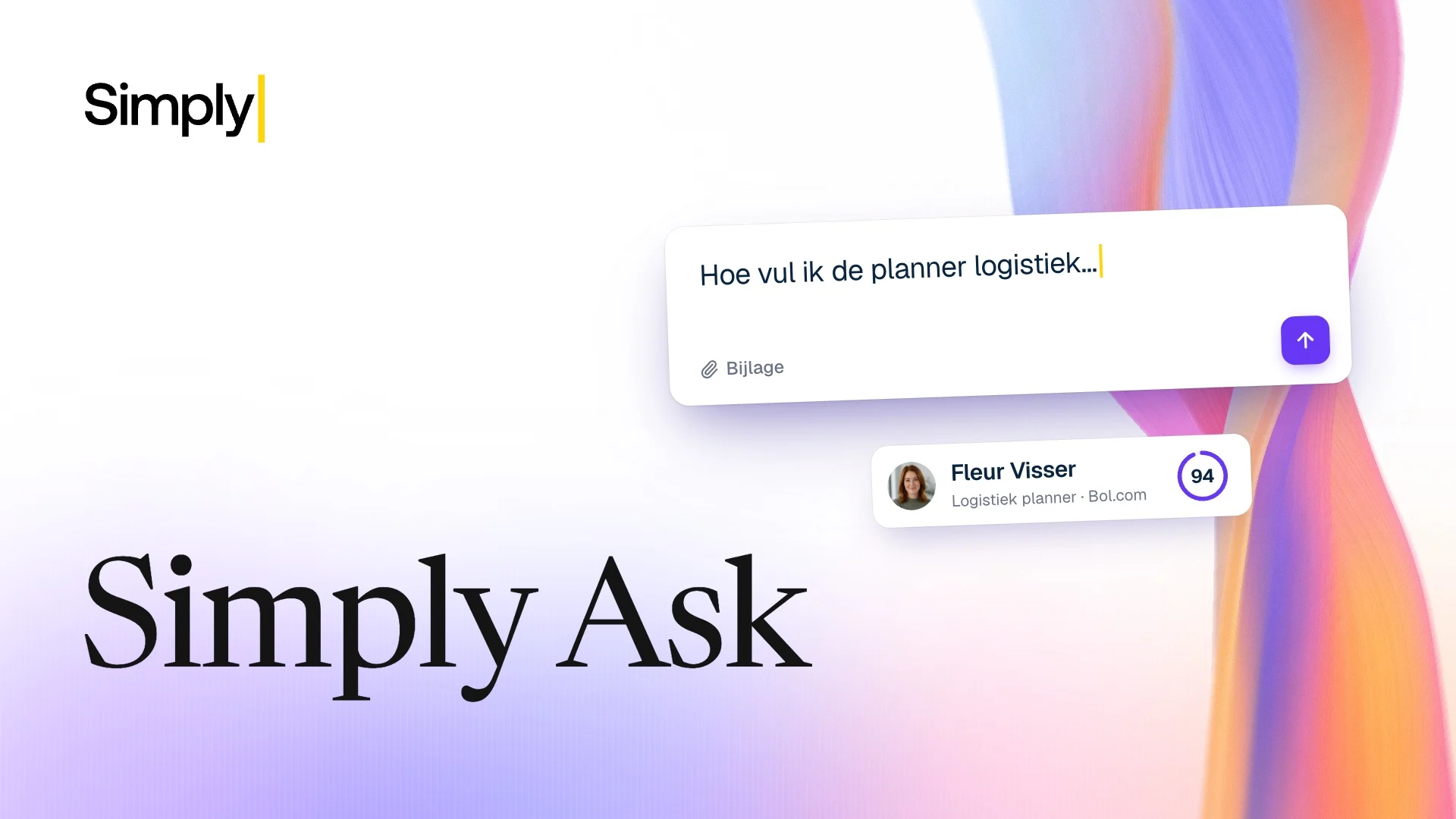
Simply Ask, the AI agent inside the ATS
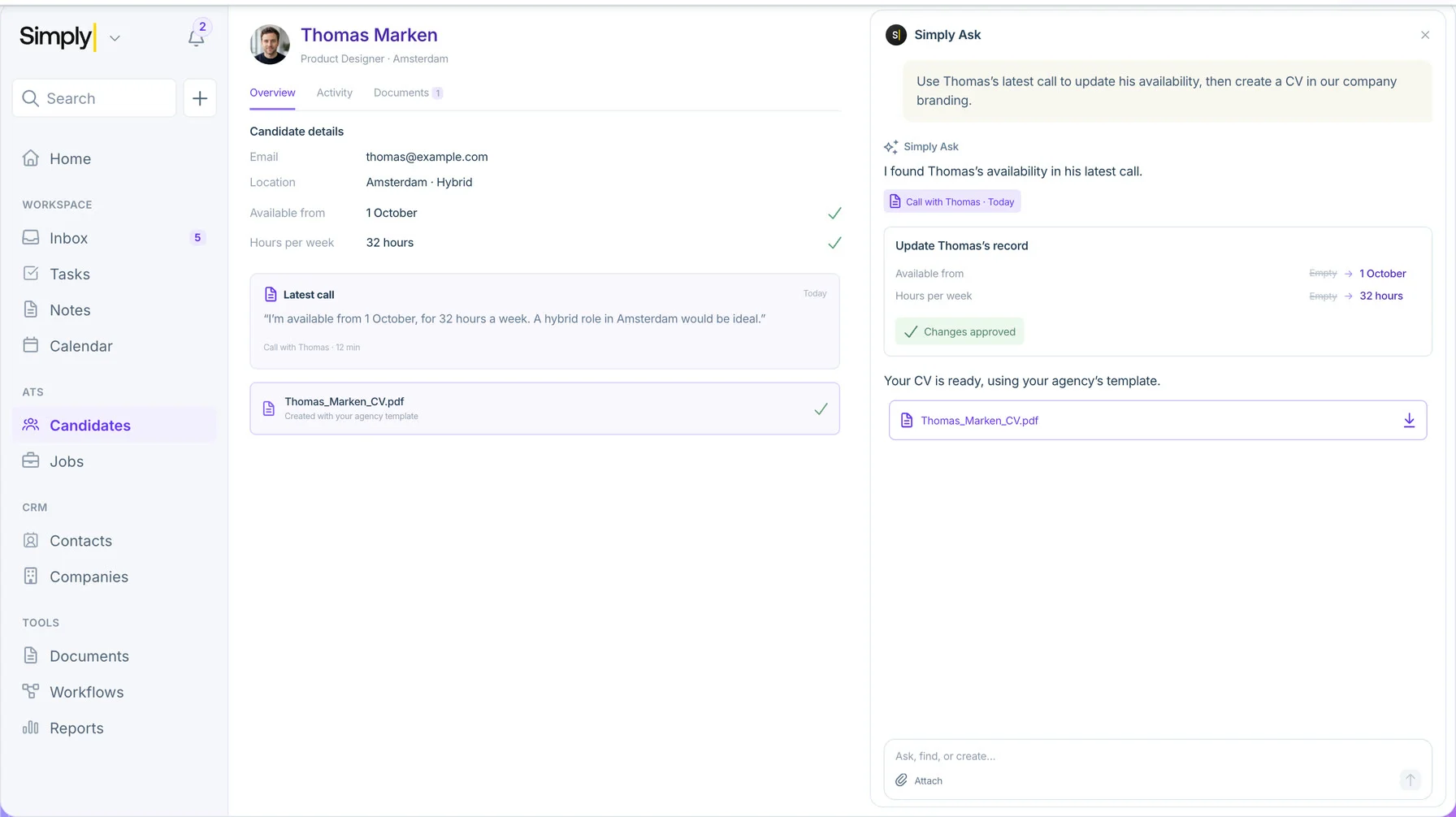
An agent that lives in the foundation of the system, so it can read whatever the user is allowed to see: records, conversations and messages. It searches, updates records, drafts emails, generates documents and builds a workflow or dashboard when asked.
4 parts
- Every change arrives as a proposal first; nothing is saved until you approve it.
- The agent never has more permissions than the user asking.
- Bring your own key: agencies pick their own AI key and model.
- Through the MCP server it also works from Claude or ChatGPT.
Unified inbox
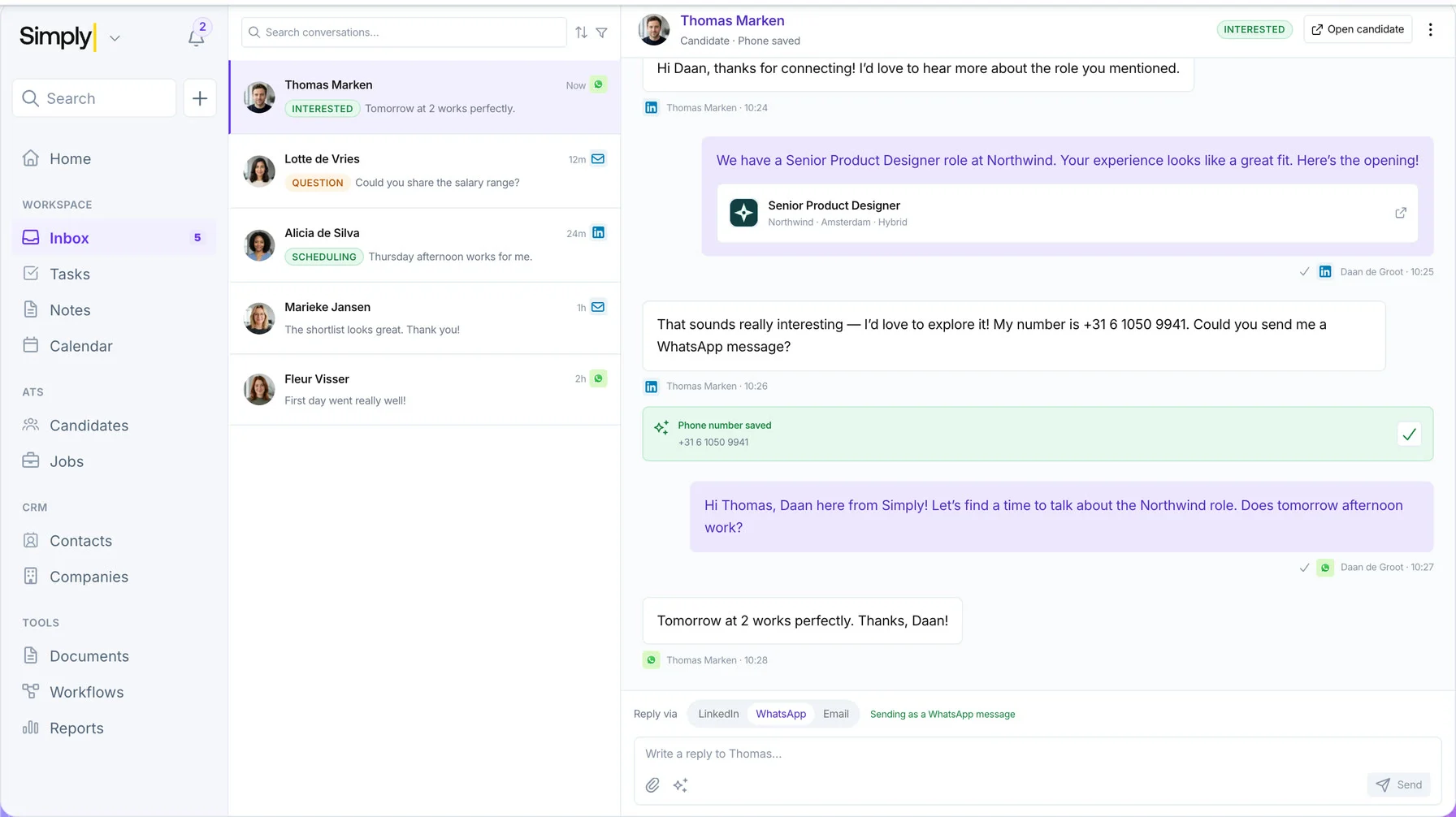
Email, LinkedIn and WhatsApp land in one inbox and attach to the right contact by email address, phone number or LinkedIn profile. A classification model that runs inside the platform itself reads the intent of every inbound message.
4 parts
- One thread per person, across every channel.
- Intent classification that follow-up flows can react to.
- Templates and AI reply suggestions for the repetitive part.
- By default no message leaves without the recruiter's approval.
Conversations: recorded, summarised, stored
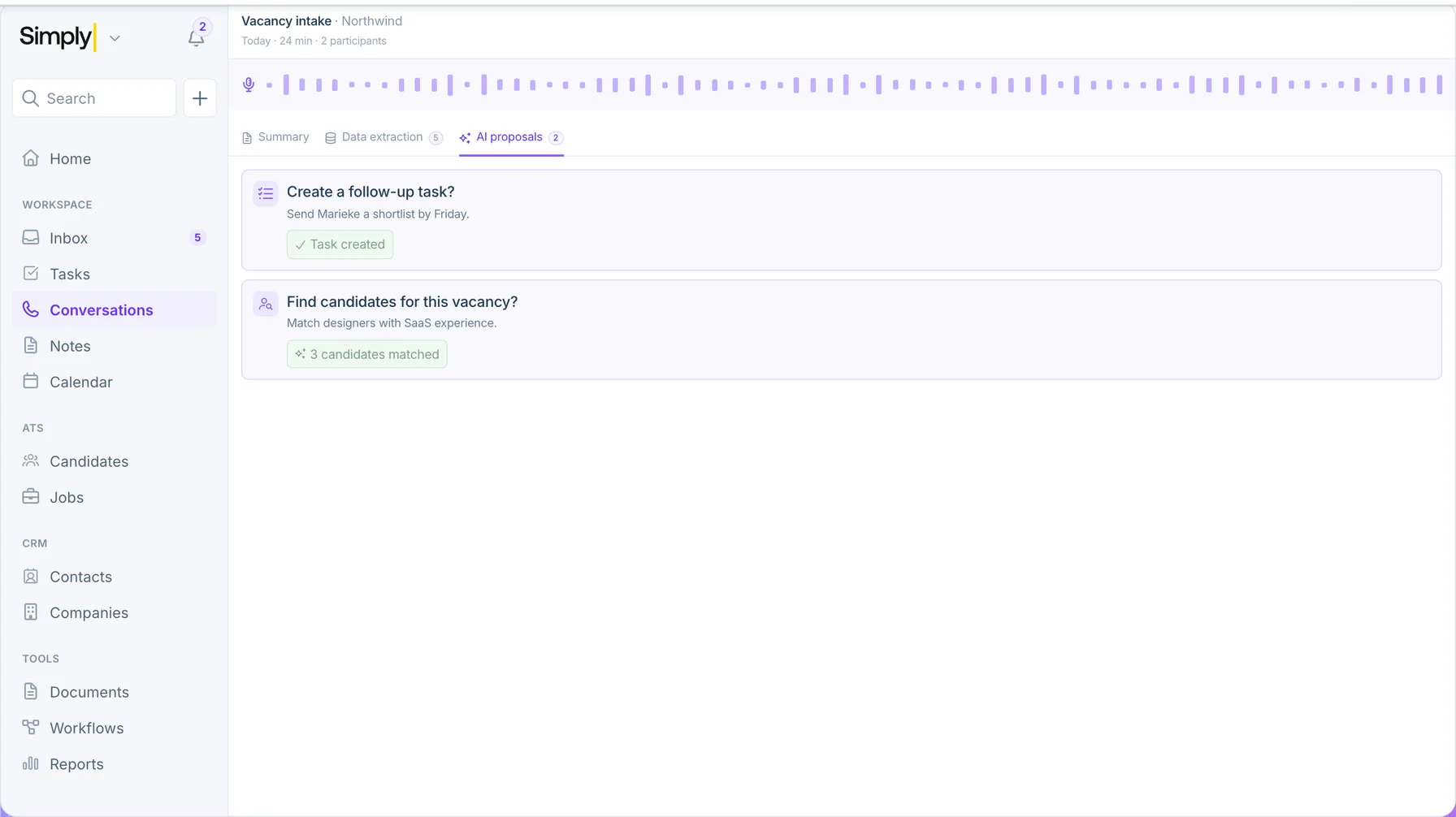
The notetaker Simply started with in 2023 is now part of the ATS. Online meetings, face-to-face conversations and phone calls are transcribed and summarised against a conversation profile, and the data points show up as a proposal on the right record.
3 parts
- Recording works online, in person and over the phone.
- Conversation profiles decide, per type of conversation, what the summary looks like and which fields come out of it.
- Every conversation stays searchable for the AI agent, years later too.
Document parsing and document creation
CVs, vacancies and contracts are read into structured fields through a mapping template. It works the other way round as well: one click turns ATS data into a CV or vacancy in the agency's house style.
4 parts
- A parsed value that would overwrite existing data becomes a proposal, not a change.
- A template builder with a design agent; start from a sample document or from scratch.
- PDF export that looks the way the editor shows it.
- Document generation as a workflow step, for a candidate introduction for example.
Search and match
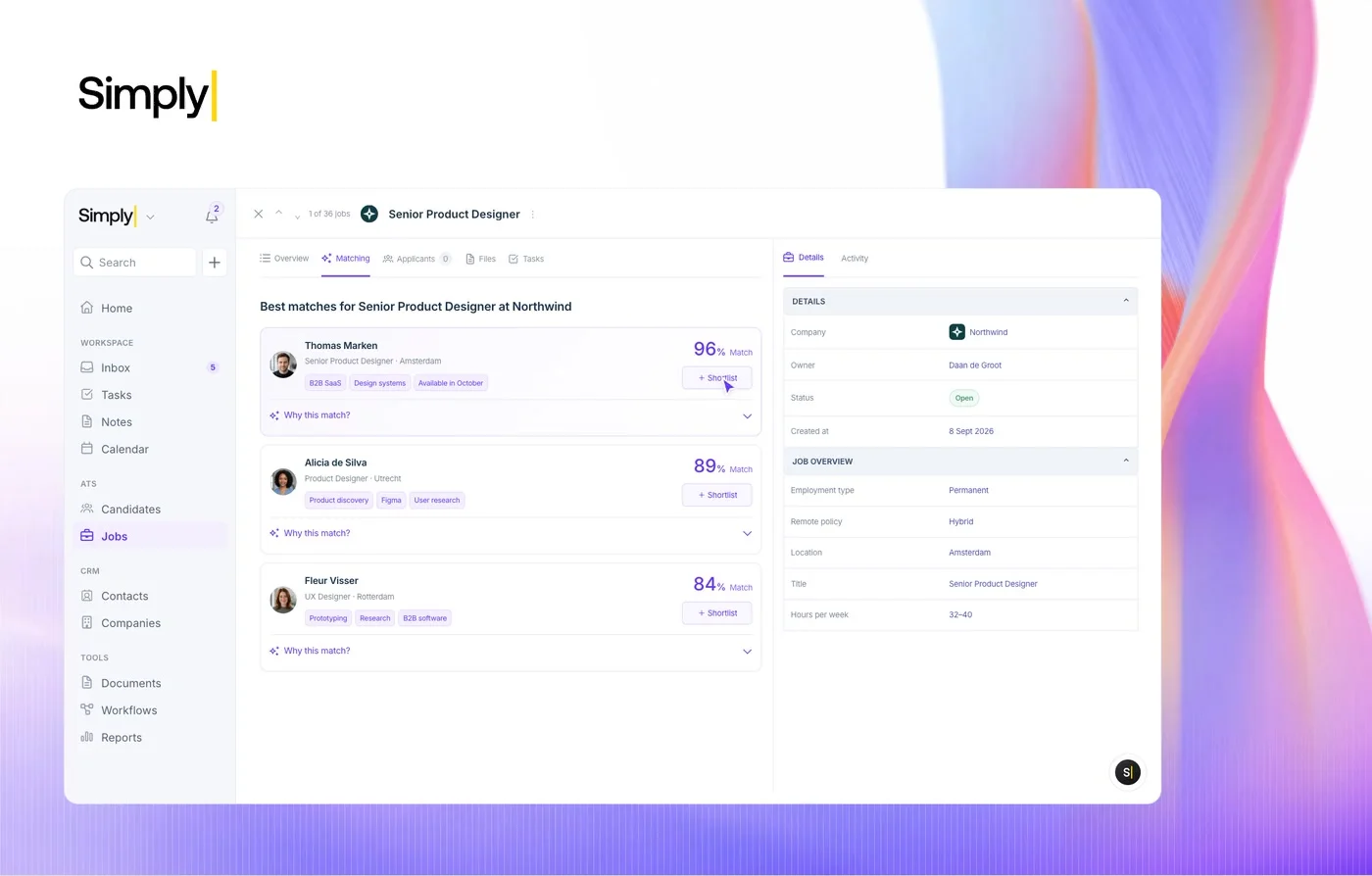
Recruiters search in plain language and Simply turns that into filters. Matching runs from a job to candidates or from a candidate to jobs, with an explanation next to every score.
3 parts
- Semantic search on embeddings in PostgreSQL with pgvector.
- Matching designed around the EU AI Act: objective criteria, anonymised data and explainable outcomes.
- The recruiter sets the weighting in the matching formula.
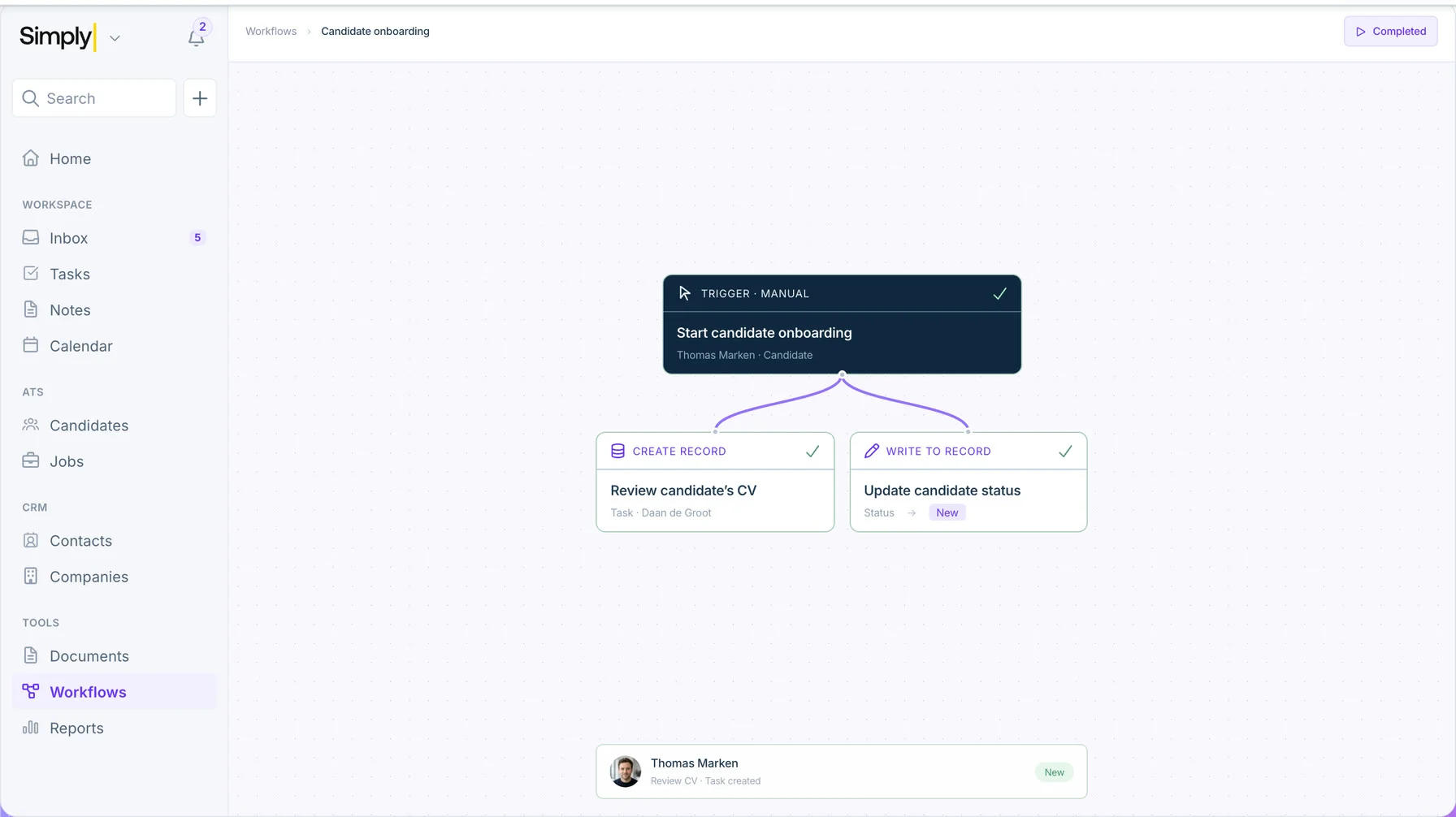
Workflow automation
A visual flow builder with triggers and actions, running on a workflow engine that remembers where it was. If something fails halfway, the run picks up from that point later and no step happens twice.
4 parts
- Triggers on record changes, schedules, a manual button or an external webhook.
- Actions that update records, prepare messages or send an HTTP request out.
- A library of ready-made workflow templates.
- The agent builds a workflow for you from a description.
Dashboards and reporting
Our own aggregation engine computes KPIs and charts over any object in the data model, and it respects the permissions of whoever is looking. You build dashboards by dragging and dropping.
3 parts
- KPI tiles, pipeline overviews and trend charts.
- Tasks, notes and calendar as widgets on the home page.
- Reports export to PDF and go out to clients by email.
API, webhooks, MCP and connectors
Everything in the data model is reachable through a public REST API generated from that model. Next to it there are HMAC-signed webhooks, an MCP server and ready-made connectors for the calendar, mail and meeting tools agencies already use.
3 parts
- API keys per workspace, revocable per environment.
- Sign-in with Google, Microsoft or LinkedIn, with optional two-factor authentication.
- Access tokens for connected tools sit with a specialised sub-processor, not inside Simply.
Product design and design system
The design of the whole application is our own work, from the first sketches and clickable mockups to the design system every screen is built on.
4 parts
- Mockups in real HTML, so a flow can be clicked through before an endpoint exists for it.
- One design system with fixed components; a new screen looks like the rest without extra work.
- List, board and detail views that work for every object, including the ones a customer adds.
- End-to-end tests that walk the main flows in a real browser.
Native Salesforce app
For agencies that stay in Salesforce there's a managed package, built in Apex. Conversation notes, CV parsing and house-style documents sit as Lightning components on the pages recruiters already open.
3 parts
- Built in Apex, with permissions, certificates, OAuth and external credentials.
- Mapping configurators that decide, per customer, which Salesforce field a data point lands in.
- Works on Salesforce-based ATSs such as Mysolution, Byner and Tigris.
Back office for customer management
An internal platform Simply uses to manage its whole customer base. Account managers set up data points, templates and conversation profiles per customer, with no developer involved.
2 parts
- Access only through a private VPN and two-factor authentication.
- Full logging and analytics for root-cause analysis and insight into how users actually work.
Marketing site and knowledge base
The site at simplyrecruit.ai was rebuilt as a static Astro site in two languages, with product demos that run as real HTML in the page instead of as video. It holds more than three hundred pages, among them feature pages, comparisons and a knowledge base.
3 parts
- Animated product demos per feature, with no video files.
- SEO setup with redirects from the old site and separate environments for testing and production.
- A Lighthouse score of 100 on desktop on every page measured.
Brand, video and marketing
Everything around the product comes from the same team too: the brand identity, the product videos and the content Simply goes to market with.
3 parts
- Product videos from script and motion design to edit and sound, among them the Simply Ask film and the founder story.
- Brand identity with email signatures and banners for LinkedIn, YouTube and Google.
- Comparison articles and knowledge-base content in Dutch and English.
Outbound sales automation
An automation for finding and enriching leads, with audience-specific messages through LinkedIn and email. A detection script also looks for signs that a prospect uses Salesforce.
4 parts
- Lead scraping from specific niches, then DMU enrichment with verified emails and phone numbers.
- Fully personalised messaging per niche and per channel, across LinkedIn and email.
- A smart Salesforce-detection script that checks company names via Salesforce URL variations.
- Three automatic follow-up sequences and real-time CRM updates on every touch.
Under the hood
One runtime for every object
Most ATSs have a table for candidates, a table for jobs, and a new table with a migration for every new wish. Simply doesn't. All records live in one generic store in PostgreSQL: the values as JSON, and the fields you sort or filter on projected next to them as typed columns, so long lists stay fast. Relations between records are separate links, not fixed references inside a table.
As a user you notice it mostly in what you no longer have to do. Adding a field takes no release and no database migration on your existing records. A whole new object, say 'Assignments' or 'Events', gets a list view, a detail page, permissions and an API endpoint right away, because the runtime doesn't know and doesn't need to know that it isn't a candidate. The ATS itself ships the same way: as a template of objects, fields and pipelines on top of the platform.
Architecturally it's a modular monolith with strict layering. The domain knows the rules, the application layer the use cases, the infrastructure layer the database and outside services, and the API layer only translates HTTP into a single use case. None of that lives in a wiki. A separate test suite checks on every build that no layer depends on another in the wrong direction, and the build fails if one does.
AI that proposes instead of overwriting
In a lot of software, AI is a button that returns text. Here it sits in three places in the system itself: in writing, in retrieval and in automation. Writing follows the rule the whole product rests on. A model is never allowed straight into the database; it files a proposal, which goes past the same permission check as a user's own action and only runs after approval. Proposal and approval end up together in the audit log.
Retrieval works on a memory layer that's fenced off per workspace. Conversations, messages and documents are turned into embeddings and searched with pgvector, after which the result is filtered down to what the person asking may see. If you have no access to a salary field, you won't get it through a detour via the agent either. Sources stay traceable, and what has to go under the GDPR goes from that memory too.
A few parts run without an outside model on purpose. The classifier that reads the intent of an inbound message runs inside the application's own process, and so does cutting the headshot out of a CV. No personal data leaves for a task that doesn't need it to.
For the tasks that do need a language model, the provider is swappable. Agencies use Simply's key or bring their own key and model; in that case they pay their AI usage straight to the provider.
Infrastructure we run ourselves
The platform and the database run on servers in the Netherlands that the team manages itself, and by default the AI processing goes through data centres in the EU as well. For an agency holding data on thousands of candidates that's no detail from the small print. It's often the first thing procurement asks.
Separation between customers runs deep. Every row in the database belongs to one workspace and authorisation is always checked inside that workspace, so one agency's data can't end up with another. Personal data is encrypted, traffic runs over TLS, and every write goes into an audit log that only ever grows. Not even an administrator takes a line out.
Around the application runs a handful of services with one job each. PostgreSQL with pgvector holds the data and the search index; a workflow engine watches long-running processes and carries on where it was after an outage; a render service produces the PDFs and an observability layer measures the cost and duration of every AI call. The admin screens of those services aren't on the public internet and can only be reached over a private network. Releases go through a test environment as container images first, and backups run daily.
Simply is ISO 27001 certified, and that certificate covers the organisation and not just the software: documented processes, access management, risk analysis and a check by an independent auditor every year.
Moving in four weeks
Choosing a new ATS is one thing; switching while the business keeps running is where it usually falls apart. That's why the move was designed as a process and not as an import button. In week one the migration team maps the existing data model, the workflows and the integrations, and a first export comes in. After that the team sets up the new environment, an admin from the agency checks that everything is right, and the agency only goes live on a fresh export.
Because the data model is made of metadata, the old system's data doesn't have to squeeze into a fixed shape: the model is formed around the agency. Simply deliberately doesn't sync with another ATS. You move once, and after that you don't keep two systems side by side.
Keeping a large codebase healthy
A system this size breaks through sloppiness, rarely through one big mistake. So a few hard rules apply. Compiler warnings count as errors, and integration tests run against a real PostgreSQL database, not a simulated one. Every error also carries a fixed code, so support and developers are talking about the same thing.
The team doesn't maintain documentation by hand. A pipeline generates the technical documentation from the code itself and rebuilds it on every change, which means what's written matches what's running. That same documentation is searchable for the AI agents the team uses while developing.
Those agents do real work. One reads every pull request and is handed exactly the design documents that belong to the changed files; another picks up bug tickets, writes a fix and submits it as a pull request, under the same tests as a person. A developer decides on every merge. It's how we build for TopDevs clients too: AI does the executing, people keep the design and the final call.
Design, video and marketing from one team
The application's design wasn't bought in. Every screen started as a mockup in real HTML, so we could click through a flow before a single endpoint existed for it, and then moved into a design system where each part exists only once. That's why an object a customer created yesterday looks as cared for as the candidate list.
The same goes for everything around it. The brand, the website with its moving product demos, the comparison pages and the knowledge base were made by the same people, and so were the videos: the Simply Ask film, the product film and the founder story never left the building between script, motion design, edit and sound. It saves handovers, and it keeps what marketing promises in line with what the product does.
The same people as TopDevs
Simply isn't a project we delivered once and then let go of. The three owners of TopDevs set the company up and led the project from the first sketch, and the team that builds and runs this platform is the team you sit down with at TopDevs. There is no second agency in between: design, architecture, code, servers, website and video come from the same hands. That's why we know what it's like to run software a business depends on: every day, with thousands of users, in several countries and under an ISO certification.
What that means for your project is concrete. The choices in this case aren't theory from a proposal: a data model that grows with you, AI that proposes and doesn't overwrite, hosting we run ourselves, and tests that guard the architecture. They're things we maintain ourselves every week. When we recommend an architecture, chances are we already have it in production.
The blueprint
- 1Capture
- 2Understand
- 3Propose
- 4Approve
- 5Match
- 6Automate
Results
Daily use
Thousands of recruiters
Recruiters in several countries work in Simply every day, from call summary to placement.
Hours back per recruiter
10+ hrs/week
With the old Simply it was 4 to 6 hours a week. The new ATS takes over far more of the administration: Simply counts on at least 10 hours per recruiter per week.
Switching
Live in 4 weeks
A dedicated migration team moves data and setup over from the old ATS and CRM, in four phases.
Hosting
The Netherlands
Platform and database on servers in the Netherlands; AI processing stays inside the EU by default.
Certification
ISO 27001
Independently audited, with a new check every year.
Marketing site
Lighthouse 100
The new site scores 100 on desktop on every page measured.
Tech & tools
“For years we built AI on top of someone else's ATS, and every new feature ran into what that system allowed. Now recruiters work in our own ATS and CRM, with an AI that makes proposals and only changes something once you approve. Design, code and hosting sit with one team, and you notice that in the pace.”
Helmer de Witte
Co-Founder, Simply
Part of our service: Software
Why teams build with TopDevs
- Fixed price, agreed up front
- 100% code ownership, no lock-in
- Prototypes in days, live in weeks
- Modern, AI-native & secure tech
Ready to build something that actually works?
Book a no-obligation call. We'll look at where the biggest win sits — fixed price, your code, no lock-in.
Start your own projectMore case studies
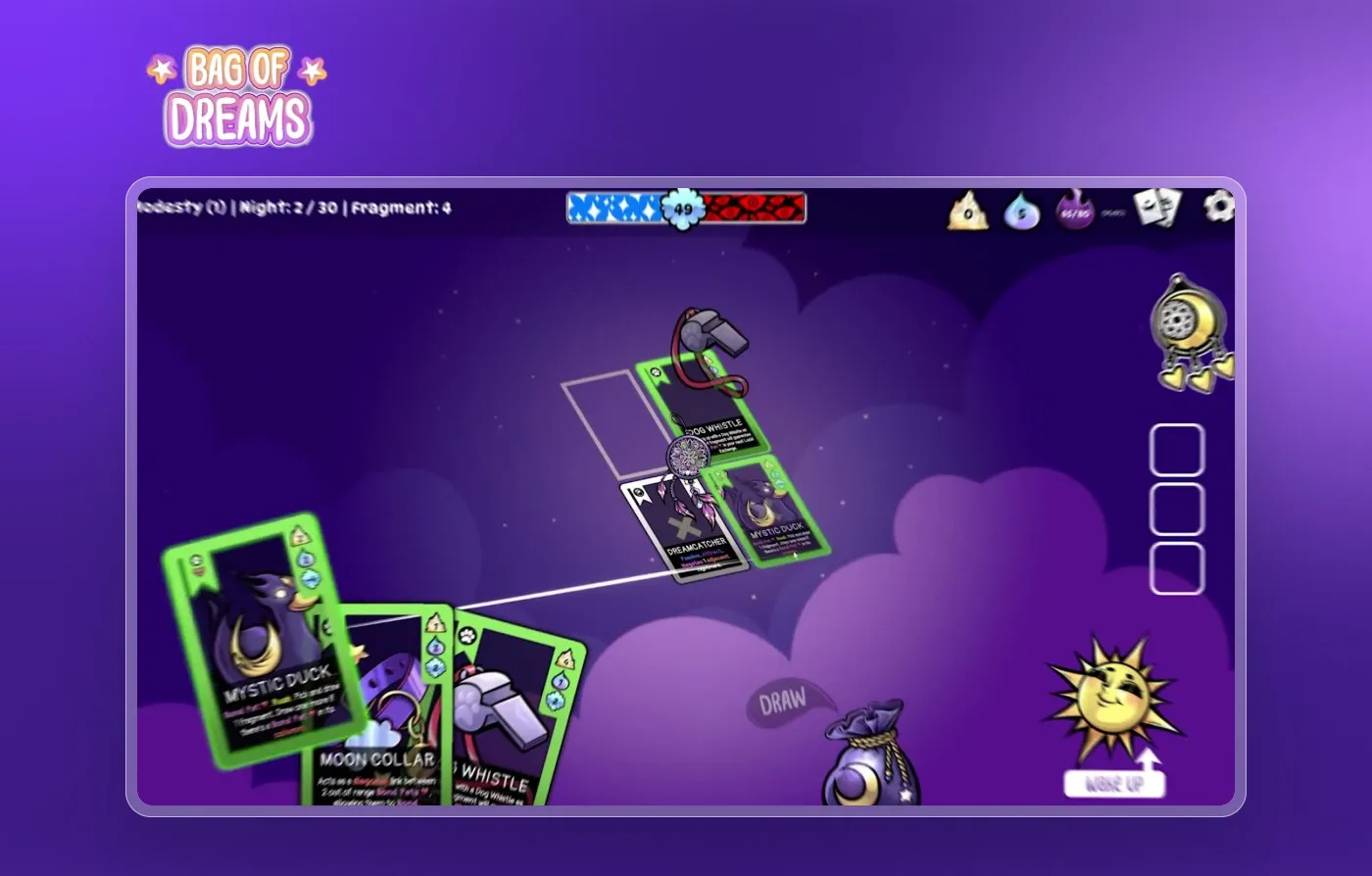
Bag of Dreams

Games
Bag of Dreams: a cozy roguelike card game, built from concept to release on Steam by two of the owners of TopDevs.
Roguelite deckbuilder
Genre
March 2026
Release
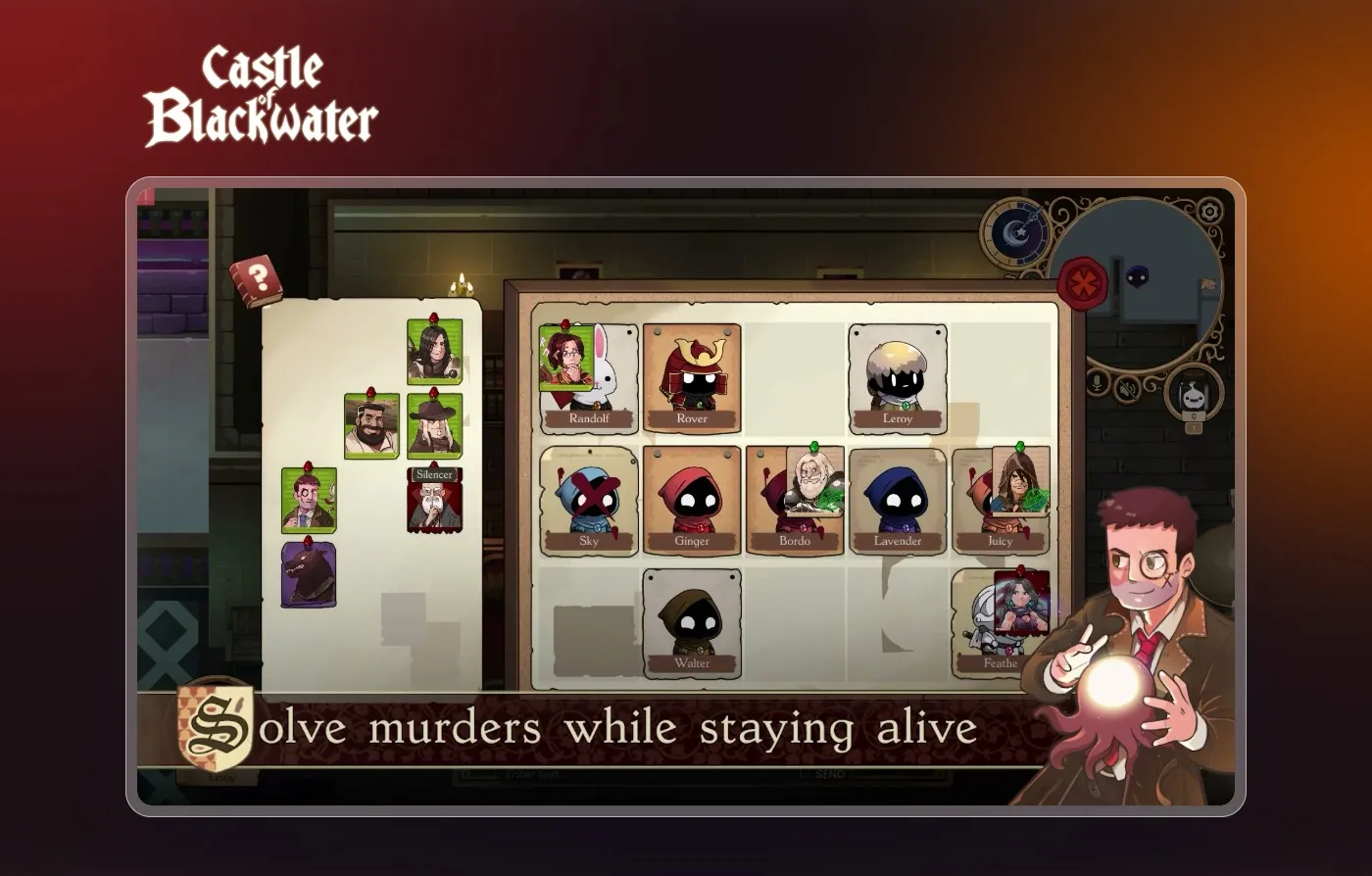
Castle of Blackwater
Games / Web3
Castle of Blackwater: a multiplayer social deduction game, built from first sketch to worldwide launch on Steam by two of the owners of TopDevs.
Up to 10
Players per round
91% positive
Steam reviews
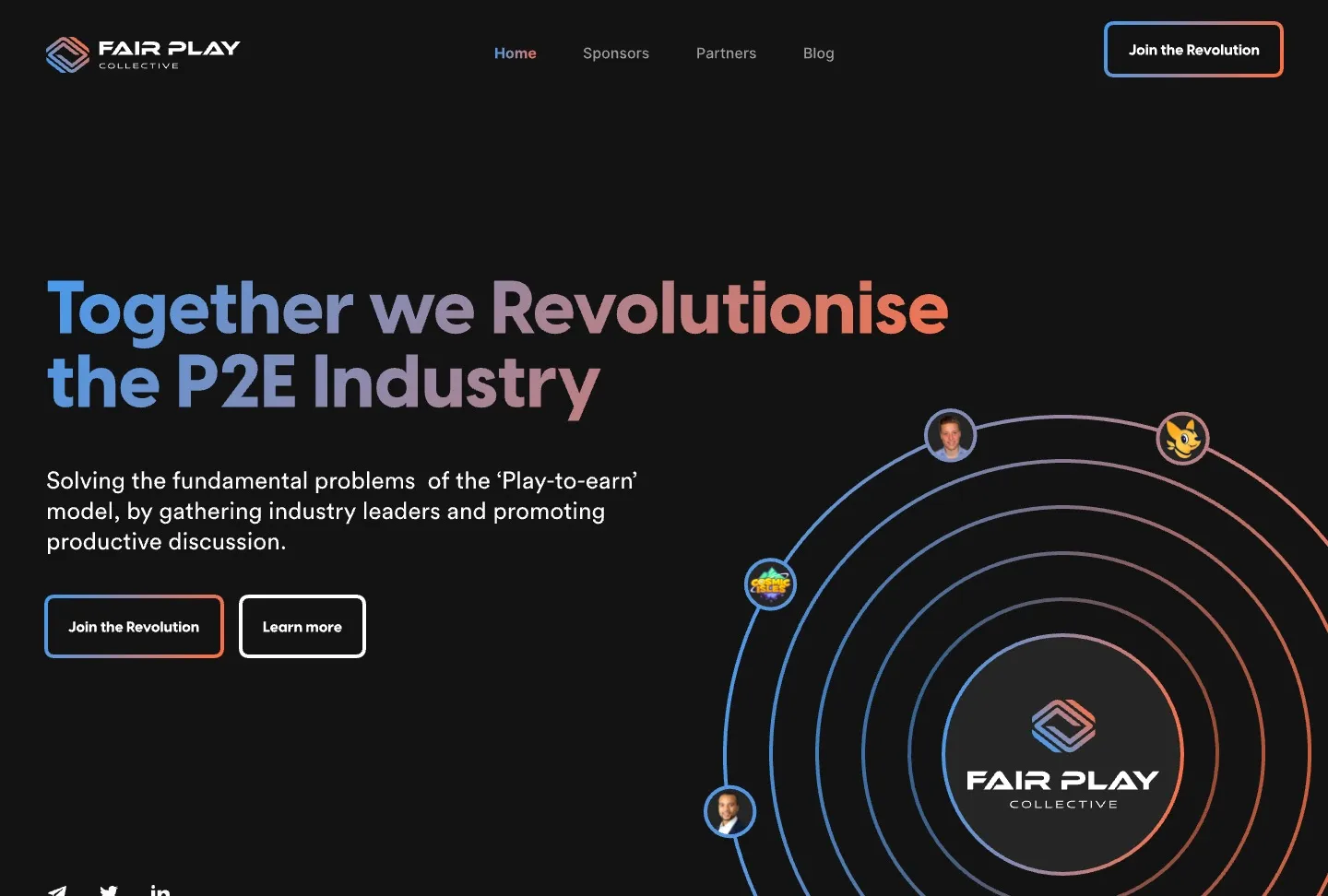
Fair Play Collective
Web3 gaming
Fair Play Collective: logo, identity, design and an animated website for a partnership in Web3 gaming.
Brand, design and site
Made
Home, blog and article
Pages